Saturday, October 11, 2025

Italian Wars: Landsknecht Units

With the release of Warlord Games' "Death and the Landsknecht" supplement, members of my gaming group are interested in running some larger Italian Wars games, particularly Pavia.  As the bulk of my current Holy Roman Empire army is made up of city militia units with only one unit of landsknecht, I decided it was time to bring some more mercenaries into the fold.

First up are two new command stands featuring Georg von Frundsberg and Götz Von Berlichingen.  The main figures are Warlord Games' dedicated miniatures, with additional miniatures from Foundry, Wargames Atlantic (conquistador drummer), and two TAG miniatures repurposed from an earlier command stand I had built.  There are some differences in figure height and bulk between the various manufactures, but I think they look reasonable enough. The figures are attached to the stands with magnets, so they can be easily broken down in the future if I want to do something different with them. 

Italian Wars landsknecht command stands for Georg von Frundsberg and Götz Von Berlichingen. 28mm miniatures from Warlord Games, Foundry, Wargames Atlantic, and The Assault Group (TAG).

Next are two large pike blocks assembled from Foundry miniatures and the plastic Warlord Landsknecht set.  There is a bit of size variation in the Foundry line, with my figures ranging 26-29mm to the eye, and the mercenary character set being much bulkier (I believe it was a different sculptor than the majority of the line).  The Warlord figures sit right in the middle of that size range, so the overall blend looks fine. I was not a fan of some of the Warlord head options (they look too big for the bodies), so I've mixed in some spare Perry heads I had in the bits box.

28mm Landsknecht pike block for the Italian Wars.  Mix of Foundry and Warlord Games miniatures, with some Perry heads

28mm Landsknecht pike block for the Italian Wars.  Mix of Foundry and Warlord Games miniatures, with some Perry heads

To support my pike blocks, I assembled some strips of Doppelsöldner with  Zweihänder swords. Depending on the rules set, they can either be added to the front rank of my pike blocks or set up as small associated units. The miniatures are a mix of Warlord Games Landsknechts, Wargames Atlantic conquistadors, and some 3D prints designed by Peculiar Companions (Erramir Orlans).  The Wargames Atlantic miniatures are bulkier than the other two lines, but I decided to still mix them.

28mm Doppelsöldner with  Zweihänder swords for the Italian Wars. The miniatures are a mix of Warlord Games Landsknechts, Wargames Atlantic conquistadors, and some 3D prints designed by Peculiar Companions (Erramir Orlans)

A Foundry great cannon and crew.

28mm Foundry great cannon and crew miniatures for the Italian Wars.

I really wanted to add some Steel Fist miniatures to my army and looked into ordering Doppelsöldner and mounted crossbowmen, but the quoted shipping from the UK to the US was astronomical (~50%), and this was even before the tariffs kicked in.  I looked at a US stockist, but their inventory was pretty threadbare.  About the only thing remaining were  knights, so I bought six with Zweihänders. As with the above Doppelsöldner, these could be added to a pike block or kept in their own small unit.

Steel Fist 28mm Italian War knight miniatures with Zweihänder swords

Lastly, there are my mounted crossbowmen.  As mentioned, I had hoped to get the Steel Fist set, but opted to buy the cheaper 3D prints designed by Peculiar Companions. They are smaller than the Perry cavalry, but are fine in separate units.

28mm Renaissance mounted crossbowmen. 3D print miniatures by Peculiar Companions (Erramir Orlans)

And with that, I think I now have enough units to more than support my portion of this project.  Now we just need to find time in everyone's schedule to get this battle started.


Friday, August 29, 2025

Baltic Independence Wars: German Offensive at Cēsis 1919 AAR


So I was finally able to meet up with my friend Art at one of the local hobby shops, where we put my Baltic Independence Wars miniatures through their first battle.  This was a fictional encounter set during the 1919 Battle of Cēsis using the Contemptible Little Armies rules. Estonian and Latvian forces (me) scrambled to prevent German Freikorps and Landwehr (Art) from seizing a critical rail station. The Baltic nationals were ordered to hold on until the last man.

The civilians had already fled ahead of the advancing armies, so the area was quiet other than a few hastily abandoned sheep.

Wargaming the Baltic Independence Wars with 28mm miniatures: Latvians and Estonians against German Landwehr and Freikorps at the Battle of Cēsis

Wargaming the Baltic Independence Wars with 28mm miniatures: Latvians and Estonians against German Landwehr and Freikorps at the Battle of Cēsis

The Estonians and Latvians launched a three prong attack. Two veteran units rushed to the station with an armored car in support. A unit of quickly raised recruits headed for the woods, while heavy machine gun and artillery teams pushed their equipment into place.

Wargaming the Baltic Independence Wars with 28mm miniatures: Latvians and Estonians against German Landwehr and Freikorps at the Battle of Cēsis

The center prong consisted of two regular infantry units who would work their way through the village and try to slow the German advance before pivoting into the far end of the station.

Wargaming the Baltic Independence Wars with 28mm miniatures: Latvians and Estonians against German Landwehr and Freikorps at the Battle of Cēsis

At the other end of the village, Cossacks galloped at top speed around the pending clash in order to flank the advancing Germans.

Wargaming the Baltic Independence Wars with 28mm miniatures: Latvians and Estonians against German Landwehr and Freikorps at the Battle of Cēsis

The Germans went with a two prong attack. As their Freikorps artillery and heavy machine guns teams maneuvered into place, Landwehr infantry and cavalry advanced through the cemetery and around the woods. A Freikorps stormtrooper squad ran towards the station, with a flamethrower equipped pioneer team in support. 

Wargaming the Baltic Independence Wars with 28mm miniatures: Latvians and Estonians against German Landwehr and Freikorps at the Battle of Cēsis

The second prong consisted of two Freikorps infantry squads who worked their way through the pasture towards the village.

Wargaming the Baltic Independence Wars with 28mm miniatures: Latvians and Estonians against German Landwehr and Freikorps at the Battle of Cēsis

Wargaming the Baltic Independence Wars with 28mm miniatures: Latvians and Estonians against German Landwehr and Freikorps at the Battle of Cēsis

The German stormtroopers managed to reach the station first, and moved into the freight depot area.

Wargaming the Baltic Independence Wars with 28mm miniatures: Latvians and Estonians against German Landwehr and Freikorps at the Battle of Cēsis

The Baltic veterans continued their advance, while the Latvian armored car opened fire on the advancing Landwehr cavalry. Unfortunately, they failed to cause any injuries. 

Wargaming the Baltic Independence Wars with 28mm miniatures: Latvians and Estonians against German Landwehr and Freikorps at the Battle of Cēsis

The other Baltic infantry continued their push through the village, highly aware of the German heavy machinegun being set up at the other end of the station.

Wargaming the Baltic Independence Wars with 28mm miniatures: Latvians and Estonians against German Landwehr and Freikorps at the Battle of Cēsis

The two squads of Freikorps infantry spotted the Cossack cavalry racing towards them and managed to kill two of the riders.

Wargaming the Baltic Independence Wars with 28mm miniatures: Latvians and Estonians against German Landwehr and Freikorps at the Battle of Cēsis

However, the Cossacks quickly closed the distance and slashed one of the infantry squads to ribbons as their Kameraden rushed to help. 

Wargaming the Baltic Independence Wars with 28mm miniatures: Latvians and Estonians against German Landwehr and Freikorps at the Battle of Cēsis

At the station, Baltic infantry exchanged fire with the stormtroopers inside the building. They failed to injury any of the Germans and sadly lost a few of their men.

Wargaming the Baltic Independence Wars with 28mm miniatures: Latvians and Estonians against German Landwehr and Freikorps at the Battle of Cēsis

Landwehr rushed to join the stormtroopers and pioneers in the station, but two members were killed by the Estonian heavy machinegun.

Wargaming the Baltic Independence Wars with 28mm miniatures: Latvians and Estonians against German Landwehr and Freikorps at the Battle of Cēsis

Baltic forces entered the passenger end of the station and contested control of the building.

Wargaming the Baltic Independence Wars with 28mm miniatures: Latvians and Estonians against German Landwehr and Freikorps at the Battle of Cēsis

Fearful of the armored car's twin machineguns, the Landwehr cavalry veered into the woods, where the raw Latvian recruits scrambled to set up a firing line.

Wargaming the Baltic Independence Wars with 28mm miniatures: Latvians and Estonians against German Landwehr and Freikorps at the Battle of Cēsis

The second Friekorps squad joined the melee with the Cossacks, but they also were no match for the slashing sabers and wild horses.

Wargaming the Baltic Independence Wars with 28mm miniatures: Latvians and Estonians against German Landwehr and Freikorps at the Battle of Cēsis

Back in the woods, luck was with the green recruits and they caught the Landwehr cavalry by surprise, killing half the unit. The survivors ran off in a panic.

Wargaming the Baltic Independence Wars with 28mm miniatures: Latvians and Estonians against German Landwehr and Freikorps at the Battle of Cēsis

The Estonian machinegun team also managed to pick off another of the Landwehr infantry before they made it to the safety of cover.

Wargaming the Baltic Independence Wars with 28mm miniatures: Latvians and Estonians against German Landwehr and Freikorps at the Battle of Cēsis

With the German machinegun now assembled and looking for targets, the Estonian infantry took shelter along the station while the Latvians hid behind a cottage.

Wargaming the Baltic Independence Wars with 28mm miniatures: Latvians and Estonians against German Landwehr and Freikorps at the Battle of Cēsis

The Estonian artillery took a shot at the Freikorps troops in the freight depot, but failed to dislodge them.

Wargaming the Baltic Independence Wars with 28mm miniatures: Latvians and Estonians against German Landwehr and Freikorps at the Battle of Cēsis

Just as the German field artillery crew were preparing to launch their attack on the station, the Latvian armored car drove up and gunned them down to the last man.

Wargaming the Baltic Independence Wars with 28mm miniatures: Latvians and Estonians against German Landwehr and Freikorps at the Battle of Cēsis

On the other side of the station, the Freikorps stormtroopers charged out of the station and brutally attacked the Estonians. The Latvians decided to risk machine gunfire and rushed to assist their allies.

Wargaming the Baltic Independence Wars with 28mm miniatures: Latvians and Estonians against German Landwehr and Freikorps at the Battle of Cēsis

At the other end of the village, the bloody battle between the Cossacks and Freikorps raged on.

Wargaming the Baltic Independence Wars with 28mm miniatures: Latvians and Estonians against German Landwehr and Freikorps at the Battle of Cēsis

Meanwhile, Germans and Latvians charged at one another along the station platform. 

Wargaming the Baltic Independence Wars with 28mm miniatures: Latvians and Estonians against German Landwehr and Freikorps at the Battle of Cēsis

The armored car moved up, hoping to support the infantry, but was disabled by the German machinegun.

Wargaming the Baltic Independence Wars with 28mm miniatures: Latvians and Estonians against German Landwehr and Freikorps at the Battle of Cēsis

Though the Latvians managed to join the melee on the other side of the station, neither Baltic unit was a match for the ferocity of the Freikorps stormtroopers.

Wargaming the Baltic Independence Wars with 28mm miniatures: Latvians and Estonians against German Landwehr and Freikorps at the Battle of Cēsis

As the German machinegun team started attacking the Latvian recruits, they were unaware the surviving Cossacks were rushing up behind them.

Wargaming the Baltic Independence Wars with 28mm miniatures: Latvians and Estonians against German Landwehr and Freikorps at the Battle of Cēsis

Wargaming the Baltic Independence Wars with 28mm miniatures: Latvians and Estonians against German Landwehr and Freikorps at the Battle of Cēsis

Back at the station, the German units defeated the Latvian veterans. All that remained were the Estonian veterans holed up in the passenger hall.

Wargaming the Baltic Independence Wars with 28mm miniatures: Latvians and Estonians against German Landwehr and Freikorps at the Battle of Cēsis

The Cossacks reached the machinegun crew and cut them down. The surviving Latvian recruits in the woods were now free to take potshots as the Germans swarming the station.

Wargaming the Baltic Independence Wars with 28mm miniatures: Latvians and Estonians against German Landwehr and Freikorps at the Battle of Cēsis

Wargaming the Baltic Independence Wars with 28mm miniatures: Latvians and Estonians against German Landwehr and Freikorps at the Battle of Cēsis

The stormtroopers began their assault on the passenger hall...

Wargaming the Baltic Independence Wars with 28mm miniatures: Latvians and Estonians against German Landwehr and Freikorps at the Battle of Cēsis

...While the pioneer squad on the other side began stealthily maneuvering their flamethrower into place.

Wargaming the Baltic Independence Wars with 28mm miniatures: Latvians and Estonians against German Landwehr and Freikorps at the Battle of Cēsis

Luckily the Estonians managed to drive off the stormtroopers and launched a successful counter-assault against the pioneers before the flamethrower could be used.

Wargaming the Baltic Independence Wars with 28mm miniatures: Latvians and Estonians against German Landwehr and Freikorps at the Battle of Cēsis

Wargaming the Baltic Independence Wars with 28mm miniatures: Latvians and Estonians against German Landwehr and Freikorps at the Battle of Cēsis

At the same time the remaining Cossacks arrived and finished off the last of the stormtroopers.

Wargaming the Baltic Independence Wars with 28mm miniatures: Latvians and Estonians against German Landwehr and Freikorps at the Battle of Cēsis

With that, there were only a few ragtag German Landwehr and their officers left on the table, and they were forced to flee.  The Estonians and Latvians had succeeded in their mission to hold the station, but at a terrible cost. It was a really close battle that could have gone either way at multiple points, and Art and I were on the edge of seats until the last round. Overall, a really fun and exciting game. 

Friday, July 18, 2025

Italian Wars: Spanish Units

 So almost a year ago I thought I had wrapped up my Holy Roman Empire army for the late medieval/early renaissance era. But as with a lot of gamers, new toys catch your eye and you find an excuse to add to your army.  For me, I was standardizing the storage boxes for this army from the mishmash I had, and now found myself with additional space in the new box that had to be filled with something.  Finding a few packs of Artizan Spanish on clearance at my local store, I thought they would make a nice addition to the army.  Of course a few packs don't add much, so I ordered two boxes of the Wargames Atlantic conquistadors to fill everything else.


First up is a command stand. Though I know Spain converted over to the Cross of Burgundy banner early in the wars, visually I don't find it very appealing and decided to use the earlier flag. Trying to paint the details in on a flag that size was beyond my aging eyes, so I just used a printed version. The commander and drummer are Wargames Atlantic plastics with a metal Artizan figure holding the banner. I think the two manufactures' figures are very similar in height and heft, so they are very easy to blend together.

28mm Wargames Atlantic Spanish Conquistador and Artizan Designs Spanish Renaissance command miniatures for the Italian Wars era

Spanish sword and bucklermen from Artizan Designs. For the heart shaped shields, you either had to fit them with the wide edge towards the hands or shoulder; I wasn't sure which would be more proper, but guessed hands.  Hopefully I got it right.

28mm Artizan Designs Spanish Renaissance sword and bucklermen miniatures for the Italian Wars era

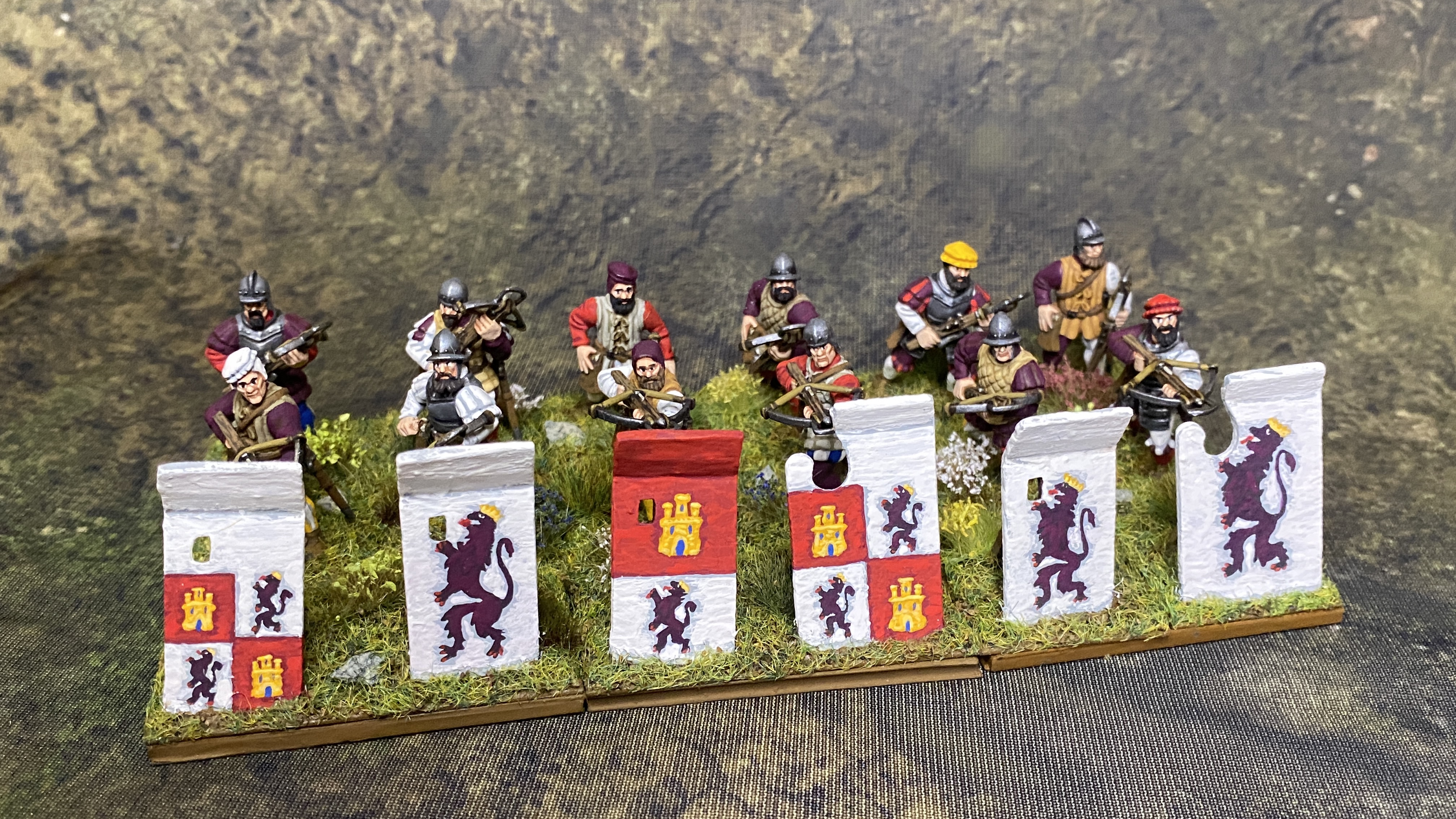
Crossbowmen from the Kingdom of León. These were made form Wargames Atlantic figures with spare pavises from Old Glory. Frustratingly, the WA kit doesn't really include enough crossbow quivers for all the figures; because I wanted more firing/preparing to fire figures rather than loading (the loading hand is sculpted attached to the quiver), I ran short by one, even using two boxes of the kit. And if you go with the arquebus handgun option instead, there are no ammo pouches included at all.  My other major complaint about the kit is that the paired arms aren’t numbered (and they aren’t always close to one another), so it was a bit of an annoying guessing game during assembly. Definitely a poor design choice by WA.

28mm Wargames Atlantic Spanish Conquistador  crossbowmen miniatures with Old Glory pavises for the Italian Wars era

Pikemen. The majority of the figures are WA, with a few Artizan thrown in. As with most of my army units, I made the artistic decision to use a unifying color palate for the unit based on the banner they carry. The WA pike are very short (approximately 50mm) compared to other manufactures, which is a bit disappointing visually.  Again, I'm not sure why WA made that decision.  One thing I will get WA credit for is the wide variety of head options available. I chose to avoid the morion helmets to give the unit an earlier feel, and I still managed to get quiet a bit of diversity of out of what remained.

28mm Wargames Atlantic Spanish Conquistador and Artizan Designs Spanish Renaissance pikemen miniatures for the Italian Wars era

Despite the shortcomings of the Wargames Atlantic kit mentioned above, I think they are a good value for the money and overall I'm happy the assembled figures. Throwing in the Artizan Design figures also gives you a bit of additional variability that only improves to the look of the units.


Thursday, May 15, 2025

Baltic Independence Wars: Final Units and Buildings

Construction for my Baltic Independence Wars project has come to a close with the last few units and bits of terrain.

First up are a unit of Astrakhan Cossacks painted as part of Bułak-Bałachowicz's Mounted Partisan Detachment. These were painted using the plate in Osprey's " Armies of the Baltic Independence Wars 1918-20" as reference.  I really like these Copplestone miniatures, but wish more than two horse poses were available.  They are a little larger than my Great War Miniatures German cavalry, but I don't think it looks too egregious on the table.

Copplestone 28mm White Russian Astrakhan Cossak Cavalry Miniatures for the Baltic Independence Wars

Next are an Estonian machinegun team and a Latvian medic.  The machinegun team is by Empress and actually comes with four figures. However, all my other machinegun teams for this era have three figures, so I elected to move the fourth figure to my artillery team. The stand for the machinegun was a little challenging to assemble, but I think I was able to hide the worst of my sins in the basing. The medic was assembled from the Wargames Atlantic plastic Great War Russian kit, with the addition of an armband I made from some thin plastic.

Empress 28mm Estonian Machine Gun Team and  Wargames Atlantic Latvian Medic for the Baltic Independence Wars. Built using Russian miniatures.

Estonian artillery team with spotter. This M1910 Howitzer is by Empress and I've added the standing officer from their machinegun team.   Looking at photos of surviving examples, they have been painted in a variety of greens; not knowing what was period correct, I've gone with just a general drab green.  The observer is another Wargames Atlantic figure.  There are no binoculars in the Russian set, so I used a pair from the WA Germans and created a neck strap from the German gasmask strap.

Empress 28mm Estonian M1910 Howitzer Team and  Wargames Atlantic Artillery Spotter for the Baltic Independence Wars. Built using Russian miniatures

The final unit is a resin Russian pattern Austin Armored Car from Empress. According to this Russian site, the Latvians received a captured Red Army Austin in 1919 that was renamed "Zemgaleetis."  It went through a few different paint schemes during its service, but I'm hoping I have the correct one for the war. For the logo, I made some decals at home; They aren't the best quality, but still look better than what I could accomplish by hand. The resin casting was pretty good, but the kit arrived with the rear fenders broken. I had to rebuild them from the remaining fragments, some plasticard, and some brass rod for the rivets. The other major challenge with the kit is there are no registration marks for the front fenders and wheels, and the two turrets. I ended up gluing some of the parts into positions that I thought were correct, but didn't fit with the other parts; So had to break them off the kit and rebuild. This resulted in some damage to the car (one of my my turrets is now a little lopsided and I had to remake some of the rivets), but I'm hoping its not too noticeable. 

Empress 28mm Latvian Russian-Pattern Austin Armored Car "Zemgaleetis" for the Baltic Independence Wars.

I also finished up a few more village buildings for the battlefield.  These are MDF kits from Things from the Basement's Russian Village line. Overall, I really like these kits. The MDF for the the main structural elements is thicker than the equivalent Sarissa Precision kits, though I did manage to break a few of the the thinner decorative elements during the building process. My one complaint would be the sizes of the doors on the kits; They come in around 30mm high, so look short with 28mm figures.

The izba log cabins come in a set of two and are very easy to assemble (you can download instructions from the company site).  The only modifications I made to the kits were to add some additional wood strips to the roof peaks in order to hide the gaps.

Things from the Basement 28mm MDF Russian-style Izba Log Cabin for the Baltic Independence Wars

Things from the Basement 28mm MDF Russian-style Izba Log Cabin for the Baltic Independence Wars

A dacha cottage house. I added some card strips to the roofline to hide the gaps. No base is included with this kit, so you're limited in how much additional basing detail you can add.

Things from the Basement 28mm MDF Russian-style Dacha House for the Baltic Independence Wars

And with that, I just need to talk someone into a game so I can get everything on the table.