Saturday, September 25, 2021

Sahel Conflicts: Terrain

I've been painting figures for a bit now, so decided it was time to prepare some terrain that was appropriate for Mail and the western Sahel.  

From the photos I've seen, a lot of the soil has an orange or pink undertone, so I am using Deep-Cut Studio's badlands mat as my base. As fighting over mostly open terrain would be rather dull, I decided a village was really needed to keep things interesting on the table. Most adobe buildings currently in production have a Middle Eastern style and aren't really quite right for the styles seen in western Africa. I spent a lot of time searching for options and thought I'd have to scratch build, but was lucky enough to finally stumble upon Fogou Models in the UK. Their line was perfect for what I wanted. 

The prices weren't cheap and shipping to the US was expensive (the resin is heavy; my village came in at 4kg), but the products were wonderful and they threw in a few extras, which was great.  Casting was top notch with minimal bubbles and clean up. There was no release compound residue, so they took primer and paint well (didn't even need to wash them). I was also highly impressed with the surface details in the stucco.  Doors came separately, and there were also lots of add ons available, so you can get fair amount of visual variety from the kits. The kits also had lift off roofs with interior detailing. If there was one downside to the line, it would be that it runs on the smaller side.  Standard 28mm miniatures on thin bases have their heads right at the top of the door frames, so heroic 28mm and the newer 32mm figures will look over-sized, particularly on a thick base.

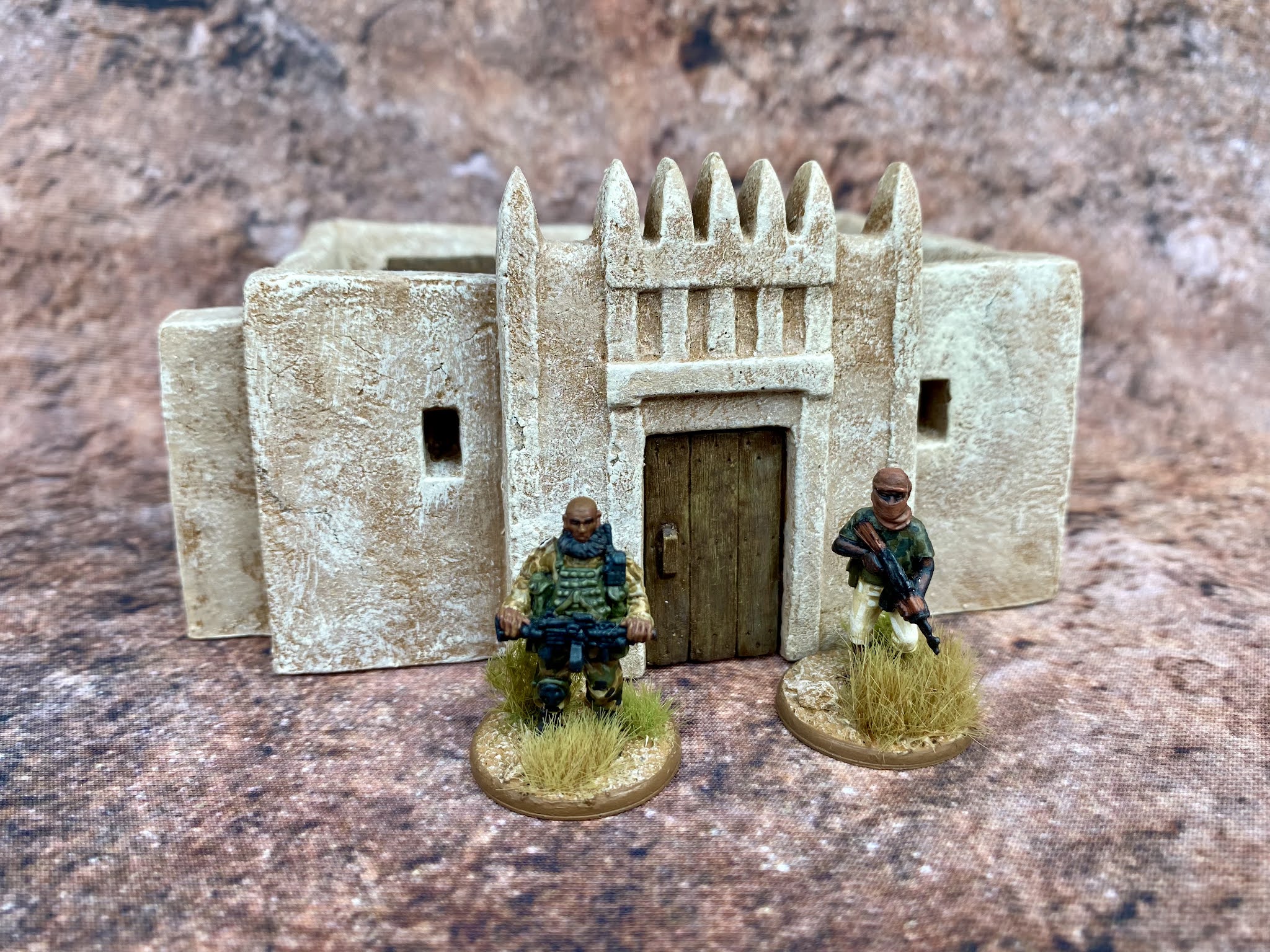
28mm Adobe Village Buildings from Fogou Models for Western Africa, Mali and the Sahel

Large Adobe 1C runs 13x9cm and will hold 6 miniatures on 25mm round bases.

28mm Adobe Village Buildings from Fogou Models for Western Africa, Mali and the Sahel

Large Adobes 1B and 1E are actually Medium Adobes 2A and 2B with Small Adobes 4E and 4F on the roofs. It's cheaper to buy them as the sets rather than the individual buildings.  For my buildings, I bought an add on frontage for one and some external staircases. The base buildings run 11.5x8.5cm and will also hold 6 figures.
28mm Adobe Village Buildings from Fogou Models for Western Africa, Mali and the Sahel

28mm Adobe Village Buildings from Fogou Models for Western Africa, Mali and the Sahel

The upper levels/small adobes run 7x5cm and will hold 2 figures.

28mm Adobe Village Buildings from Fogou Models for Western Africa, Mali and the Sahel

Medium Adobe 3C is 10x7.5cm  and can hold 4 figures.

28mm Adobe Village Buildings from Fogou Models for Western Africa, Mali and the Sahel

The Adobe Bakehouse has the same 7x5cm footprint seen in the small buildings for the rectangular section and a 5cm diameter tower. There is no internal floor, and you can fit 3 figures if you use the tower.

28mm Adobe Village Buildings from Fogou Models for Western Africa, Mali and the Sahel

The granaries in the Medium Adobe 2A set are comprised of the same buildings in the Small Adobe section (again, cheaper to buy as a group) and are all around 5cm in diameter, with space inside for a single figure. My kits did not include the small doors or roof posts, so I'm not sure if that was an oversight or if it's how they are sold.  Regardless, it was easy to create them out of balsa wood and bamboo grilling skewers.

28mm Adobe Village Buildings from Fogou Models for Western Africa, Mali and the Sahel

The kits themselves only came with flat roofs, but the village photos often depicted granaries with thatch roofs, so I decided to make some from scratch. These were made from stacked cones of heavy card with the aforementioned bamboo skewers used to reinforce the points.

Making 28mm Thatch Roofs  for Western Africa, Mali and the Sahel

These were then covered with strips of teddy bear fur, with the tops scalloped to help them fit around the cones. To hold the fur down before the next steps, they were given a coating of Woodland Scenics' scenic cement.

Making 28mm Thatch Roofs  for Western Africa, Mali and the Sahel

The thatch tie downs were made from braided thread and glued down with super glue, before the entire assembly was painted with various shaded of brown and gray.

Making 28mm Thatch Roofs  for Western Africa, Mali and the Sahel

Fogou wall segments run about 8.5cm long, and this gate height gives you a good impression of the clearance for 28mm figures. Realistically, you'll need 2 or more sets to really do anything with them.

28mm Adobe Walls from Fogou Models for Western Africa, Mali and the Sahel

A bit of scatter terrain for the village. I'll also throw in some of my old Ainsty Castings bits and will look for some additional elements in the future.

28mm Scatter Terrain from Fogou Models for Western Africa, Mali and the Sahel

In addition to the village, I also made some rock and tree elements using bits from Woodland Scenics and Gamers Grass.

28mm Model Rock Formations for Western Africa, Mali and the Sahel

Living in a small space, I generally have to transport my terrain to play elsewhere, and I've always had problems with my trees starting to fall apart over time. As such, I tried a new tree technique this time in hopes they will last longer . Previously, I had use the large foliage clumps glued directly to the tree armature, but for this build, I first glued down large clumps of their light green polyfiber, coated it with a generous amount of Scotch Super 77 spray adhesive, and then used the finer underbrush light green clumps.  It seems to have formed a stronger bond, but the annoying bit is the glue dried a milky color rather than the promised clear. As such, you can see webs of white between the leaves.  There's not much I can do at this stage, but my hope is they will look like fine branches in the top of the trees.

28mm Model Trees for Western Africa, Mali and the Sahel

Lastly, since this is a farming village, I needed something for them to farm. Looking online, cotton is a major export crop for Mali, and corn is a food staple, so I thought those were good places to start. Both crops were produced by JTT Scenery Products.  The local shop only had HO scale cotton in stock, but I think the size looks ok (I have them mounted on thin  plasticard, so I don't think they sit a deep as intended).

JJT Scenery Products 28mm Cotton Crops for Western Africa, Mali and the Sahel

I was able to find the corn in O scale, but did end up trimming some of the bottoms off the stocks to keep them from looking too big.

JJT Scenery Products 28mm Corn/Maize Crops for Western Africa, Mali and the Sahel

I might still pick up a few additional odds and ends, but I think this will give me a good skirmish table for my modern games, and I could also see it being pressed into service for my 19th century African games as well.

Monday, September 13, 2021

Sahel Conflicts: More Modern French Foreign Legion

Work continues on my French Foreign Legion for Mali and the Sahel. As before, these are a combination of Eureka Miniatures and JJG Print 3D figures. To help distinguish the combat groups on the table, I've done one with tan body armor and another with green. Webbing remains a mix of both colors. Painting recipes are on the previous post.

8mm modern French Foreign Legion for Mali and the Sahel from Eureka and JJG Print 3D

Combat  Group 1:NCO and 300m Team with FAMAS rifles and AT4s

8mm modern French Foreign Legion for Mali and the Sahel from Eureka and JJG Print 3D

Combat  Group 1: 600m Team with FAMAS rifles, Minimi MG, and LGI Mile F1 mortar

8mm modern French Foreign Legion for Mali and the Sahel from Eureka and JJG Print 3D

Combat  Group 2: NCO and 300m Team with FAMAS rifles and AT4s

8mm modern French Foreign Legion for Mali and the Sahel from Eureka and JJG Print 3D

Combat  Group 2: 600m Team with FAMAS rifles, Minimi MG, and LGI Mile F1 mortar

8mm modern French Foreign Legion for Mali and the Sahel from Eureka and JJG Print 3D

For the FN MAG 58 machine gun, I've opted to base it as a team rather than as individuals as is standard in Bolt Action.  I had some challenges with the primary gunner, both in terms of painting in all the nooks and crevasses, and in accidentally  breaking some of the finer details off during painting. He also didn't want to sit flat on the base, so had to hide some of the gaps with basing details and the other figures. But in the end, I think I got him reassembled well enough was happy with the final product.

8mm modern French Foreign Legion for Mali and the Sahel from JJG Print 3D

8mm modern French Foreign Legion for Mali and the Sahel from JJG Print 3D


Monday, August 30, 2021

Sahel Conflicts: Modern French Foreign Legion

With the insurgents complete, I've started working on my French Foreign Legion. Currently, no single company makes all the pieces I wanted, so I've gone with a combination of Eureka Miniatures and JJG Print 3D figures. Based on information from people with more knowledge than me, the Eureka figures are good for the 1990-2000s, and the JJG for the 2010s to present (depending on the sculpt). Since I was planning to game Operations Serval and Barkhane in the early 2010s Mali, I figured a transitional force wouldn't look grossly out of place.  I still have more to paint, but have completed a command team, a combat group, and some specialists

28mm modern French Foreign Legion for Mali and the Sahel from Eureka and JJG Print 3D

Command Team: 2 officers, medic and radio operator

28mm modern French Foreign Legion for Mali and the Sahel from Eureka and JJG Print 3D

NCO and 300m Team with FAMAS rifles and AT4s

28mm modern French Foreign Legion for Mali and the Sahel from Eureka and JJG Print 3D

600m Team with FAMAS rifles, Minimi MG, and LGI Mile F1 mortar

28mm modern French Foreign Legion for Mali and the Sahel from JJG Print 3D

Two-man sniper team with FR F2 sniper rifle and suppressed HK416; Special forces drone operator

28mm modern French Foreign Legion for Mali and the Sahel from Eureka and JJG Print 3D

Tracker Unmanned Aerial System (Note: I don't think this drone type was deployed in the early 2010s, but drone options are limited) Edit: Raphael Longbow, the sculptor for JJG Print 3D, sent me a message on Facebook to clarify that the drone model is actually a DRAC, which became operational in 2008.

28mm modern French Foreign Legion for Mali and the Sahel from JJG Print 3D

I am in no way an expert on the French Foreign Legion, so I found the Foreignlegion.info site to be invaluable in terms of painting references.  From photos of troops deployed in Mali, it seems that camouflage was mostly the desert pattern, with some temperate pieces as well.  Webbing elements tended to be tans and greens, with some individual soldiers having a mix of the two. As such, I've decided to go with a mix of appearances to add more variety and make it easier to differentiate between combat groups.

If anyone is interested, here are the painting mixes I came up with:

Desert Camo: Vallejo 891 Iraqi Sand base with Vallejo 821 German Beige and Vallejo 983 Flat Earth splotches; Wash with a mix of Vallejo Mecha Weathering 521 Oiled Earth and 522 Desert Dust
Temperate Camo: Vallejo 884 Stone Grey base with Vallejo 893 US Dark Green, Vallejo 871 Leather Brown, and Black splotches; Wash with Army Painter Soft Tone
Tan Webbing: Vallejo 821 German Beige with Vallejo 884 Stone Grey highlights; Wash with Vallejo 521 Oiled Earth
Green Webbing: Vallejo 887 Brown Violet with 924 Russian Uniform highlights; Wash with Army Painter Soft Tone
Metal Equipment: Vallejo 894 Camouflage Olive, with Camo Olive/833 German Camouflage Bright Green mix; Wash With Secret Weapon Green Black

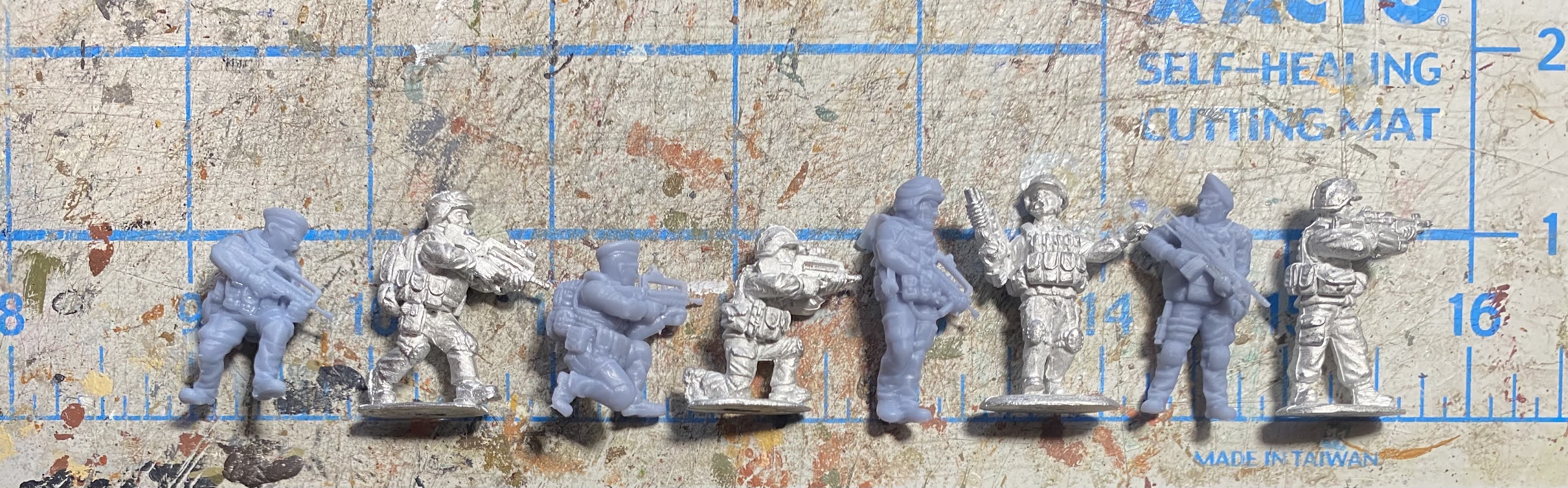
Since people are also curious to see how figures mix with one another, besides the painted figures, here are some of both manufactures in the raw. 

28mm modern French Foreign Legion from Eureka and JJG Print 3D: Size Comparison

 The JJG figures are slightly taller than the Eureka and are also a little bulkier, with it being particularly noticeable in the helmets. Similar to injection plastics, some of the details can be softer than seen on the metal Eurkea figures, but it also allows the use of thinner parts (check out the radio antenna on the commander's walkie talkie or the sunglasses in the hands of the AT4 operator wiping his eye) Overall, I think once painted they blend in well on the table and I would recommend both manufactures wholeheartedly.

Saturday, August 14, 2021

Sahel Conflicts: More Insurgents and Journalists

 The last of my insurgents are now ready for the table.

28mm African Islamic terrorist insurgent miniatures

This batch of insurgent infantry comes from The Assault Group's terrorist line rather than than the Africa irregulars, as I thought both the clothing and sculpting style was a better match for my current miniatures. In addition to the AK equipped members, I grabbed some PK machine gunners and a couple of snipers with SVD-63 Dragunov rifles. Sculpting was good, but I had to do a lot of clean up in the space between the arms and body.  Additionally, all the rifle barrels were badly bent coming out of the packages, and they took a fair amount of work to get straight (and I managed to break one during the process). TAG may want to looking into using thicker foam in their packaging to prevent this.

28mm The Assualt Group (TAG) terrorist insurgent miniatures

28mm The Assualt Group (TAG) terrorist insurgent miniatures

Next up is the Footsore technical and machine gun with an Empress gunner.  The body of the technical was a well cast resin piece and I had no issues with the primer and paint sticking to it.  Detail parts were white metal, and you got a variety of options, not all of which I used here. 

28mm Footsore terrorist insurgent technical with Empress miniature

28mm Footsore terrorist insurgent technical with Empress miniature

As Toyota seems to be the king of technicals, I used some Woodland Scenics dry rub decals to add the company name.  They were a bit fiddly to apply compared to wet decals, but I think the final effect is acceptable.

28mm Footsore terrorist insurgent technical with Empress miniature

I also added some brass rod clippings to look like spent shell casings in the truck bed.

28mm Footsore terrorist insurgent technical with Empress miniature

Finally, I painted up a few Empress journalists to use as objective markers during games. The sculpting of the main reporter's face unfortunately looked a bit like Voldemort with its very flat nose, but what are you going to do. The "Press" wording was added to his vest using more of the dry rub decals.

28mm Empress journalist miniatures

The journalist figures were another of the oversized type Empress is releasing in their modern range. As you can see below, this supposed 28mm figures is almost 33mm to the eye when on its base. I'll just have to say it's a Dutch news crew if anyone comments on the height.

28mm Empress journalist miniature - size is way too big!

Which brings me to the next question, how do all these ranges in my force compare to one another?

28mm Modern Miniature Size Comparison: The Assault Group (TAG), Footsore, Empress, Eureka
Left to Right: The Assault Group, Footsore (no cast base), Empress (base removed), Empress (base removed), Eureka

28mm Modern Miniature Size Comparison: The Assault Group (TAG), Footsore, Empress, Eureka
Left to Right: The Assault Group, Footsore (no cast base), Empress (base removed), Eureka

28mm Modern Miniature Size Comparison: The Assault Group (TAG), Footsore, Empress, Eureka
Left to Right: The Assault Group, Empress (base removed), Footsore (no cast base), Eureka

As you can see, there was some height variability among the Empress figures, and with the bases removed it was hit or miss on if they would still tower over the other miniatures. Figure bulk varied across the brands, with Footsore being on the thin side, Eureka somewhere in the middle, and Empress and TAG being a bit more hefty. Weapon sizes were fairly close across all the brands. With the unifying paint jobs and basing, I think they we will generally look good en mass, with perhaps just a few figures that shouldn't be put in the same units.

With that, it is now time to start on the French Foreign Legion force to counteract them.


Saturday, July 31, 2021

Sahel Conflicts: Islamic Insurgents

 During a virtual painting meet up, one of my gaming group members floated the idea of moving forward in time from our usual WW2 games and trying some modern skirmish wargaming. Though I've been trying to resist the urge to start a new project, he didn't have to twist my arm too hard to take the plunge. We toyed with a few options (Middle East, Afghanistan, former Soviet territories), but decided Africa gave us the best option in terms of army variety and not requiring a lot of vehicles.

28mm African Islamic terrorist insurgent miniatures

From my perspective, I thought the Mali insurgency in the early 2010's seemed the most interesting, so I started with an insurgent force appropriate for there. That said, I wanted it versatile enough that it could represent an Islamic terrorist group from any anywhere across the Sahel, from Ansar Dine in the west to Boko Haram in the east.

My initial purchase was some masked Somalis from Eureka USA, which I felt made great generic Africa insurgents. They also make bareheaded gunmen, but I thought that the bare chests and short pants of some figures looked out of place in an Islamic force. The figures are technically very well sculpted (particularly the weapons), but I do find some of them stiff and lacking in a lot of individual character.  However, they do paint up quite nicely.

Eureka Miniatures 28mm masked Somali gunmen used as African Islamic terrorist insurgents

Eureka Miniatures 28mm masked Somali gunmen used as African Islamic terrorist insurgents

There were no heavy weapons in the Eureka Somali range, so I picked up a Russian SPG-9 recoilless rifle from their Afghanistan range instead. The SPG-9 was used in the Mali conflict, and since the figures were masked, I thought a bit of blue robing could turn them into a reasonable facsimile of Tuareg rebels.

Eureka Miniatures 28mm Afghan recoiless rifle used as African Islamic terrorist insurgents

The next batch of figures I ordered were the Boko Haram insurgents from Footsore North America. The figures are thinner in style than Eureka's and a hair taller, but they do not have cast bases, which leaves the finished figures at a similar height.  While I think the sculpting quality is rougher than Eureka, these figures have a ton of character (the bearded machine gunner is my favorite in the army) and bring a lot of life to the force.

Footsore Miniatures 28mm Boko Haram used as African Islamic terrorist insurgents

Footsore Miniatures 28mm Boko Haram used as African Islamic terrorist insurgents

The last batch of figures I ordered were the Empress Miniatures, and these proved somewhat problematic. I had previously bought some of their Abyssinia and WW2 figures (both excellent), and they were a good size match to my Eureka and Footsore miniatures. So I expected the same with their modern line. However, it appears they were using a different sculptor and the figures were closer to 1/48 than the usual 1/56 (one figure was almost 32mm from base to eye).  I cut the bases off to help, and while pack INS02 looked more reasonable, the INS11 pack was still relatively big looking, particularly with the overly elongated necks on the figures.

Empress Minatures modern figures are 32mm (1/48) rather than the stated 28mm (1/56)

I was really unhappy with how they were looking, so decided to take the radical step of beheading them and removing a few millimetres of neck, covering the cut with some putty.

Empress Minatures modern figures are 32mm (1/48) rather than the stated 28mm (1/56)

The modifications helped, but I still found the INS11 body proportions off, with skinny torsos, fat heads, and arms that seemed too long (pack INS02 was much better sculpted). 

Empress Minatures modern figures are 32mm (1/48) rather than the stated 28mm (1/56)

As you may be able to tell, the Empress modern figures were not my favorites, and with the larger sizes and hit and miss sculpting quality, I think I will avoid this line in the future. But that said, I was able to hide these in my army without them being a major eyesore.

Empress Miniatures 28mm (ish) Insurgents used as African Islamic terrorist insurgents

Empress Miniatures 28mm (ish) Insurgents used as African Islamic terrorist insurgents

In terms of painting, this was a new challenge for me, as I'm not really experienced at painting camouflage uniforms, and my usual painting style uses few to no washes (but most modern army painting videos recommend their use for shading). It was a bit of a learning curve, but I think I got better as I progressed through the figures and overall I'm happy.  For the paint schemes, I used a lot of reference photos of insurgents in Mali, Chad and Nigeria. Uniforms seemed to be quite a mishmash of camouflage patterns, even in the same units, so I tried to reflect that here. I also tried to throw in a little bit of blue fabric to represent the Tuareg elements. For the skin colors, I mostly went with dark and medium brown sub-Saharan tones, with a few lighter skinned figures to represent Berber fighters who had come south.

As with most of my hobby projects, there has been some scope creep, so I have some more insurgents making their way to the painting desk (including a technical), and then will move on to some French Foreign Legion to battle them.  My local opponent has yet to select and paint an appropriate force of his own, but my hope is we'll be able to to get these on the table later in the year.