Saturday, March 1, 2014

The Lost Outpost: A Colonial Africa AAR

 Today Axabrax and I finally managed to meet up at the local shop and play our first colonial Africa game using the "In the Heart of Africa" rules, with 600 points allotted to each side.  Steve fielded a Ruga-Ruga force, while I had a German force.


Our table consisted of a lost trading outpost on the edge of swamp.

 A local German commander was tasked with reclaiming the outpost.  For this dangerous mission, he was given a detachment of crack naval troops, with help from some Azande natives and a Boer settler acting as scout.  As they approach the outpost, things look quiet.

 Little do they know, a force of Ruga-Ruga and local tribesmen are waiting in the jungle for them.

 The Germans station a machine gun on the hillside to cover their advance. One naval unit heads towards the tall grass, while another moves towards the outpost.  Azande are hidden in the jungle on their right flank in case there are surprises.

The naval troops headed towards the outpost are suddenly hit by artillery, instantly killing two of the five sailors.

A sinister witchdoctor explores around the outpost, attempting to flush out any hidden troops. 

The surviving sailors from the outpost attack run to join their colleagues in the underbrush, hoping to hide from additional artillery fire.

A group of Masai warriors in the employ of the Ruga-Ruga follow behind the witchdoctor, while additional Ruga-Ruga move around the outpost and head for the stream.

The witchdoctor finally succeeds in flushing out the Azande, who manage to kill him before he can place a curse on them.

Meanwhile, the advancing unit of Ruga-Ruga reach the stream. After loosing a few members to crocodile attacks, the Germans open up on them with machine gun and rifle fire, eventually doing enough damage to drive them away.

The Masai now engage the Azande.  The Azande manage to hold their ground for a while, but they are fewer in number and are slowly being killed off by the swarm of Masai.

 The commander and his forces take cover in the undergrowth, hiding while the machine gun does its best to dominate the field.  The Ruga-Ruga artillery attempts to pound the machine gun into silence, but is unable to hit its target.

 The Ruga-Ruga take a significant amount of punishment from the machine gun, but manage to hold their ground.

The Ruga-Ruga artillery switches targets to the Germans in the grass, wiping out one of the Naval units. Native archers emerge from out of the jungle to engage the remaining Germans. 
 
German forces sweep right out of the undergrowth, eliminating the archers.  The machine gun continues its attack on the Ruga-Ruga at the jungle's edge, further reducing  their numbers. The Ruga-Ruga artillery is still unable to silence the machine gun. 

 The Masai finish their slaughter of the Azande warriors.

From the hilltop, the Germans spot the advancing Masai, knowing they bring certain death if they can reach the remaining sailors.

The sailors reposition the machine gun, mowing down the advancing Masai, until the losses are so severe that the Masai must flee.

With the machine gun occupied, the Ruga-Ruga artillery finally manages to dial in on it and destroy it.  The remaining Ruga-Ruga infantry pour through the undergrowth towards the Germans.

Finally it comes down to hand to hand combat, with both sides nearly equal in numbers. It's anyone's victory!

It's looking bad for the Germans; everyone has been killed except the command group. Doom seems certain!

Little did the Ruga-Ruga leader know that the commanding officer was a devil with pistol and knife, reducing them all to bloody corpses.

The outpost may still be lost, but one lone German commander survives to journey back to civilization and share this tale of bravery and death.

It was a great afternoon and both of us were happy to finally have someone local interested in African games.  As our schedules allow, more African adventures will be forthcoming.

Saturday, February 22, 2014

African Savannah Mat

So far I've been using my standard green flocked mat for my African figures, but I've never been happy with it, as I feel it doesn't look right for the African savannah.  As such, I've been on the search for something more appropriate that wouldn't break the bank.  I've seen several people using variations on teddy bear fur, and came across this well done tutorial from Thames Valley Wargamers.  It didn't seem too complicated, so I decided to give it a shot.

Strolling through the local fabric store, I came across both long haired fur (as seen in the tutorial) and short haired synthetic felt .  The long haired fabric ran $12 per yard vs. $5 for the short, so I opted to go the cheaper route.  Plus, it would save me having to shave the fabric and I thought it would look better if I wanted to also use it for 15mm figures.  The cloth was 45 inches across, so almost perfect for a 4x6 table. The store had 4 colors available: chocolate brown, honey, ivory, and grey.  The honey was a bit more yellow than I wanted (my hope was for a tan), but it seemed the best choice out of what was available. I picked up 9 feet of material; 6 for the game mat, and 3 for test painting and use in making terrain pieces for the mat.

I wanted my mat to look appropriate for the start of the dry season, so I decided it would have hints of greens, but would be mostly yellows and tans.  As such, I picked up the following acrylic paint colors: Hauser Light Green, Citron Green, Golden Straw (All from Americana paints), and Sandstone (Apple Barrel paints).  The tutorial recommended diluting the paint with water and applying with a sprayer, but did not say how much to dilute it.  I originally tried approximately 1 part paint to 3 parts water, but it ended out coming out spotty on the test cloth:


To try to minimize the damage done to the cloth, I decided to spread these spots out using a sponge.  I first went with the nape of the cloth, then against it to try to make clumps and waves of color.

As I continued with the additional colors (I was going from dark to light), I moved on to 1:5 mix ratios, which helped improve to paint spread, but I still rubbed it in against the nape in random directions with a sponge to minimize color clumping.  At the end of the afternoon, I ended up with this:


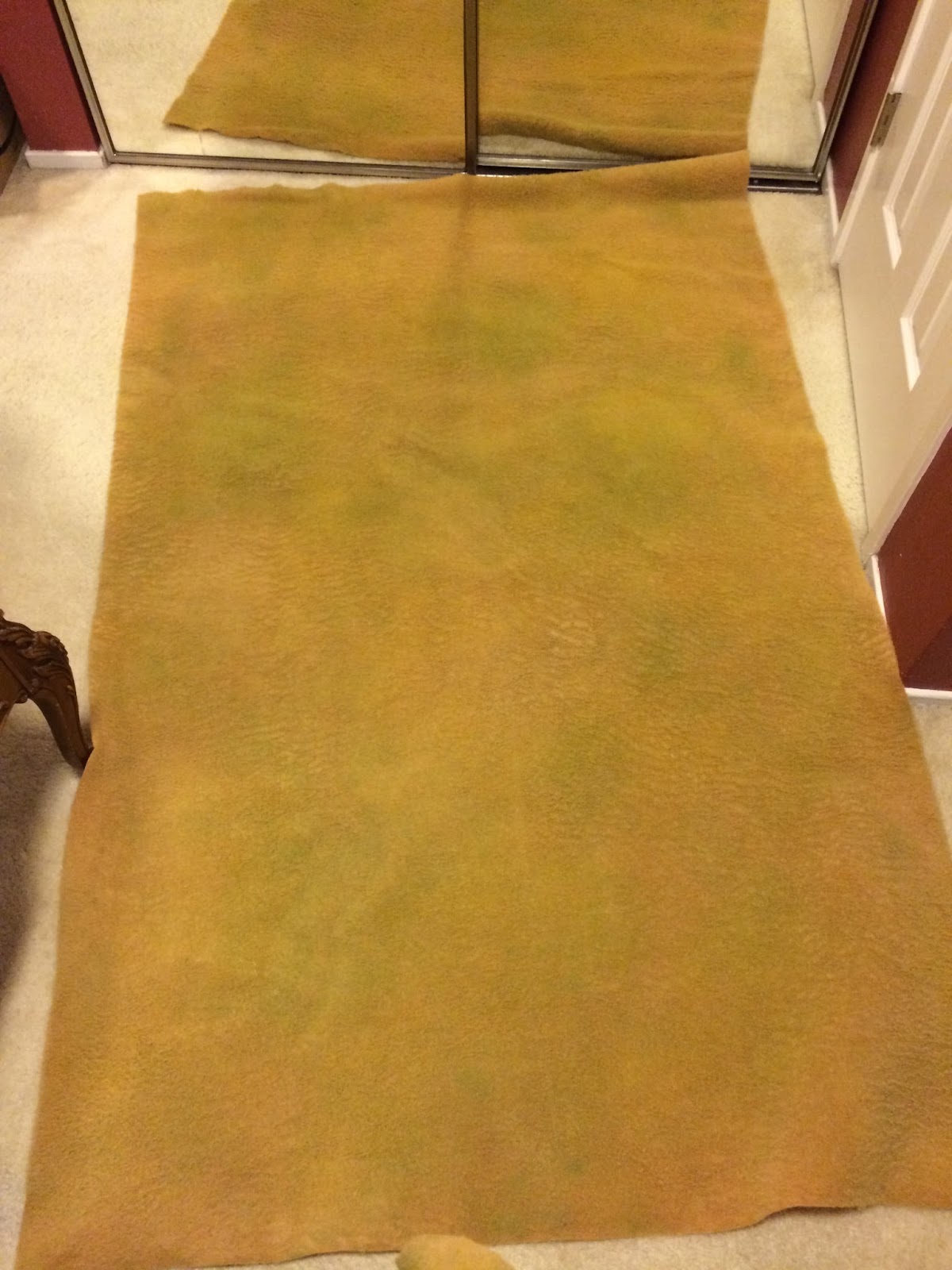
The color changes were subtle, but I thought it looked pretty good on the patio.  However, that changed once I brought it indoors and looked at it under artificial light.  The color differences were not really apparent and overall it just looked too yellow.  A second round of spraying was going to be required and I'd have to better saturate with paint.

For round two, I decided to start with the sandstone and then go from dark to light with the greens/yellow.  I also decided to dilute the paint more (1:10) in hopes of having it work further into the hairs.  At this dilution, the spray was a much finer mist that spread better.  I put on a bit more than last time, and let some areas sit as is, while using the sponge on others (again against the nape).  This resulted in something a bit better:


With the additional paint covering the fabric, the hairs also started to clump in nice waves, giving a nice random pattern to the texture which I liked. At the end of round two, I ended up with a mat that had much more pronounced color difference (at least in the sunlight):


So how did it look once I got it inside?  Under bright florescence lighting it held up pretty good, but under more yellow "warm" lighting, it wasn't a s bold as outside.  However, I think it will still work ok.


The only thing I was a bit disappointed about is that the bulk of the color work seems to fade away when you get up close, so it doesn't work as well as I hoped for photographing miniatures up close.


Still, at the end of the day I am happy with what $20 of supplies and two afternoons of work got me.

Monday, February 17, 2014

King's African Rifles

Well I'm back with another unit for my Deutsch-Ostafrika WWI project (as well as VBCW).  These are members of the King's African Rifles (KAR).


 I have painted this unit to represent the 2nd Battalion from Nyasaland as pictured in Plate F in Peter Abbott's, "Armies in East Africa 1914-18".  The uniforms are described as khaki, but the illustration shows something a bit lighter in color, which I copied here.   Also of interest is the illustration shows a diamond shaped cap badge,  while the text on page 45 states they should have a rectangular badge and 1st Battalion should have the diamond. I've again stuck with what is shown in the illustration.

Figures were obtained from Brigade Games.  They are both well sculpted and cast. 

Friday, February 7, 2014

African Porters


So I'm back with some more figures for my African WWI gaming.  These are porters from Old Glory's Darkest Africa line.  I've discussed my unhappiness with them before in passing, but haven't given you a chance to see them up close.


You get four body types, and five head types, though I have only used four (the fifth was carrying elephant tusks, which don't really fit the part of a military baggage train). The heads do not fit well on the bodies, and you will need to add green stuff to the necks to keep them from looking ridiculously thin. The muscles also look lumpy, with quite a few of the arms at odd angles, with protruding elbows that make the figures look like they were sculpted wearing gauntlets. 

Here are some other angles to show you the strange arms and over-sized back muscles. 

The casting quality was also really bad, with strange lumps or holes in the figures.  For example, in the first photo, look at how all the cases have chunks missing from the lower corner.  There were also a lot of misaligned molds when the heads/baggage were cast, resulting in the need to do a lot of filing and filling.  You can see some of this misalignment in the second photo, on the crate carried by the porter on the left (this is even after all my work to minimize it).

The also set comes with a guide and two porters carrying a lion corpse, but I have not yet painted those.

Overall, I am not really happy with them and would not have made my purchase if I knew what I was getting.  However, with quite a bit of work I think they will look acceptable on the table, and I did get a lot of figures to create an impressively sized baggage train.


Thursday, February 6, 2014

Music for African Adventures

As I've mentioned before, I like to have appropriate music for my painting and gaming adventures.  Now that my African figures are back on the worktable, I thought it was time to put together some music to inspire me.

Source: Wikipedia


This station is a mix of orchestral adventure music and traditional African songs from across the continent.